Garments & Apparel · Baby Clothing
Baby Clothing Manufacturing and Sourcing in India
Baby clothing is one of the most demanding apparel categories: the fabrics must be soft, the trims must be secure, and every chemical and safety rule for infant products applies. India is a leading source of cotton babywear, with deep expertise in fine jersey, interlock and muslin, and a large pool of GOTS-certified organic cotton supply chains.
We help baby brands, retailers and subscription-box companies find factories that are set up specifically for babywear, not general factories that make baby sizes occasionally.
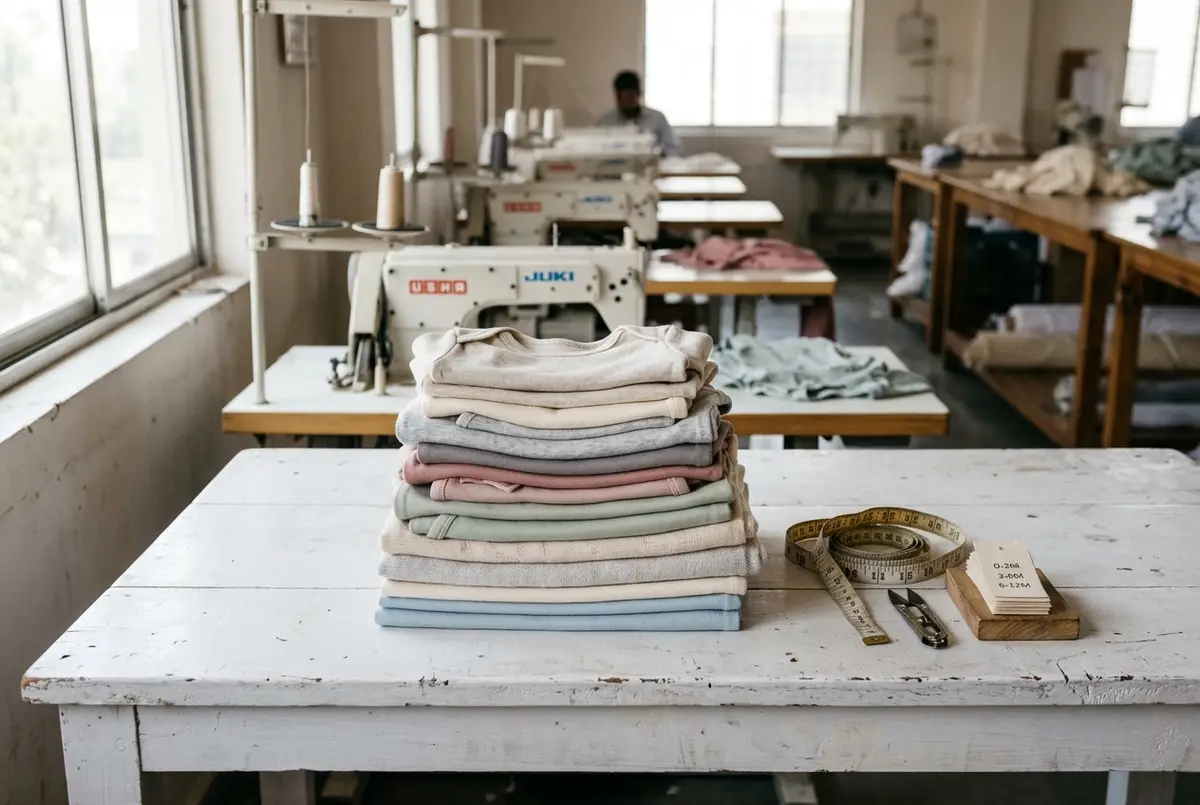
Baby clothing we source
Bodysuits and onesies with envelope necks or side snaps, rompers and sleepsuits with zip or snap fronts, footed and footless pyjamas, gift sets, bibs, hats, mittens and booties, muslin swaddles and burp cloths, sleeping bags, and newborn layette packs. Many factories also make matching sibling and parent styles, which helps brands build family collections from a single supplier.
Sizes usually run from premature and newborn up to 24 or 36 months, so a single style can have eight or more sizes. Size ratios and pack configurations should be confirmed before costing.
Fabrics for babywear
Combed cotton single jersey and 1x1 rib are the most common bases, followed by interlock for warmer, smoother garments and double-layer muslin (gauze) for swaddles and summer sets. Organic cotton, bamboo-derived viscose and cotton-modal blends are popular for premium ranges. Fabric weight, shrinkage and softness after washing should be agreed with physical swatches, because babywear buyers judge the hand-feel first.
Undyed or natural-dyed fabrics are sometimes requested. Natural dyes vary from lot to lot, so colour tolerance and lab-dip approvals need extra care.
Where babywear is made in India
Tiruppur in Tamil Nadu is the centre of cotton knit babywear, with knitting, dyeing, printing and garmenting units close together. Many Tiruppur factories already hold GOTS, OEKO-TEX and social-compliance audits for European buyers. Woven baby items such as muslin swaddles, smocked dresses and embroidered sets are also produced in Delhi NCR, Jaipur and parts of Gujarat.
Safety requirements for baby clothing
Babywear must be designed out of risk. Avoid cords and drawstrings at the neck and hood, keep decorative trims to a minimum, and specify snap and button pull-strength requirements. In Europe, EN 14682 covers cords and drawstrings, and REACH restricts substances such as azo dyes, nickel and certain phthalates. In the United States, CPSIA sets lead and phthalate limits and requires a Children's Product Certificate and permanent tracking labels; infant sleepwear has specific flammability exemptions for tight-fitting garments.
Factories making babywear should operate a needle-control policy, with broken-needle records and metal detection before packing.
Testing plan
A typical plan covers fibre composition, dimensional stability, colour-fastness to washing, rubbing, saliva and perspiration, pH, formaldehyde, azo dyes, snap attachment and pull strength, and lead in surface coatings or metal snaps. Print inks should be phthalate-free. Tests are booked with recognised third-party labs, and reports are matched to the production lot.
Construction and quality points
Seams should be flat and soft against the skin, with covers-stitch or flatlock finishes, and care labels should be printed or placed where they do not irritate. Envelope necks must stretch over a baby's head without distortion. Snaps should be set with the correct die and reinforced with interfacing. At inspection we check measurements across all sizes, snap security, print cracking after a stretch test, loose threads and any sharp points, and we confirm metal-detection records for every carton.
Packaging and presentation
Baby gift sets often involve boxes, ribbons, tissue and swing tags, and multi-packs need consistent folding and banding. Polybags must carry suffocation warnings in the required languages and sizes. If you sell on marketplaces, carton labels and barcodes must meet each platform's receiving rules.
Minimum orders and costing
Minimums depend on fabric. Stock organic jersey can allow small runs per colour, while custom-dyed fabric or all-over prints usually need several hundred to a few thousand metres per colour. Costing should separate fabric, printing or embroidery, snaps, labels, packaging, testing and inspection, so you can see the effect of each design choice.
Sourcing tips for baby brands
Keep a stable core of bodysuits and sleepsuits in the same base fabric, and add seasonal prints on top. Order the snaps and trims early, test them before bulk, and keep approved golden samples for every size. Plan your testing timeline inside the production calendar, not after it, because a failed test late in the process is the most common cause of delayed babywear shipments.
Gift sets and bundles
Babywear sells strongly as gifts. Sets combining a bodysuit, hat, bib and mittens, or a swaddle and sleepsuit, need coordinated fabrics and colours and carefully designed packaging. Plan component quantities so each set completes without leftovers.
How a baby clothing sourcing programme runs
- Brief review. We review your tech pack or reference sample, target price, quantity and timeline, and confirm what is realistic in India.
- Factory shortlist. We shortlist factories in the right cluster and verify them on site: legal entity, in-house processes, capacity and compliance.
- Sampling and costing. We manage proto, fit and size-set samples and collect costings broken down by fabric, trims, labour and finishing.
- Pre-production approval. Fabric tests, lab dips, trims and a pre-production sample are approved in writing before bulk cutting.
- Production follow-up. We track cutting, sewing and finishing against the agreed calendar and run inline quality checks.
- Final inspection and shipment. A final random inspection to your AQL, carton and label checks, then handover of documents to your forwarder.
What to include in your baby clothing brief
- Size range from newborn upwards
- Fabric type, weight and certification
- Snap, button and zip references
- Safety and testing requirements per market
- Print artwork and placement
- Care and tracking labels
- Gift packaging and polybag warnings
- Target price, quantities and delivery date
Common mistakes when sourcing baby clothing
- Assuming a factory's GOTS certificate covers its dyer and knitter as well.
- Approving snaps on sight rather than with pull-strength tests.
- Placing sewn care labels where they rub against delicate skin.
- Planning lab tests after production instead of inside the calendar.
- Using decorative ribbons or bows that can detach.
- Leaving polybag warnings and language requirements until packing starts.
Other apparel categories
Garment sourcing services and guides
Garment sourcing by buyer market
Back to Garments & Apparel sourcing
Buyer questions
Is India a good source of organic baby clothes?
Yes. Tiruppur has many GOTS-certified knitters, dyers and garment factories; the certificate must cover every processing stage and the producing site.
What tests are needed for baby clothing?
Typically colour-fastness including saliva, pH, formaldehyde, azo dyes, snap pull strength and, for the US, CPSIA lead and phthalates.
Can factories make small baby clothing orders?
Yes, using stock fabrics. Custom colours and prints need higher fabric minimums.
Do baby garments need metal detection?
It is strongly recommended and commonly required by retailers to control broken needles.
How many sizes does a babywear style usually have?
Often six to eight, from newborn to 24 or 36 months, which should be reflected in the size ratio and costing.
Submit your product requirements
Submit your product requirement
Share a photo, reference product or tech pack. We will identify suitable verified manufacturers and explain the next steps — no obligation.
- Phone & WhatsApp
- +91 93684 37527