About
Global Garment SourcingGarments & Apparel HubGarment Sourcing OverviewIndia Garment SourcingBangladesh Garment SourcingNepal Garment SourcingChina Garment SourcingThailand Garment SourcingVietnam Garment SourcingApparel ManufacturersPrivate Label ClothingFabric & Textile SourcingSustainable ApparelQuality Control & Factory AuditsCountry ComparisonGarment Sourcing Enquiry
What We SourceServicesGlobal MarketsQuality ControlSourcing Stress TestInsightsContactStart a Sourcing Project →

Stainless steel houseware · Buyer-side sourcing in India

Stainless Steel Utensil & Kitchenware Manufacturers in India

India has a deep stainless steel houseware industry. Utensil centres such as Jagadhri in Haryana, the Delhi NCR and the Mumbai–Thane region produce bowls, plates, cookware, storage containers, tiffins and kitchen tools. Moradabad adds serveware, barware and hotelware.

Sourcing India works on the buyer's side for importers, retailers, hospitality suppliers and private-label brands. We specify the right grade and thickness, find and verify suitable manufacturers, approve samples, inspect production and coordinate export.

Stainless steel kitchenware and utensils prepared for export inspection

Stainless steel products we source

Kitchen tools & utensils

Ladles, turners, skimmers, whisks, tongs, graters and utensil sets. Handle construction, weld or rivet quality and edge finishing decide how long a tool lasts.

  • Solid, hollow and wire handles
  • Mirror, satin and matte finishes
  • Sets with stands, hooks or gift boxes
Kitchen tools & utensils guide →

Bowls, plates, trays & servingware

Mixing and serving bowls, thalis and plates, platters, trays and buffet serveware. Sheet thickness and edge rolling are the main quality and price drivers.

  • Deep-drawn and spun forms
  • Double-wall and hammered designs
  • Nesting sets for efficient freight
Bowls, plates, trays & servingware guide →

Storage containers, canisters & tiffins

Canisters, airtight containers, masala boxes, lunch boxes and multi-tier tiffins. Lid fit and gasket material matter as much as the steel.

  • Clip-lock, screw and press-fit lids
  • Silicone gaskets specified for food contact
  • Leak tests on sealed designs
Storage containers, canisters & tiffins guide →

Colanders, strainers & sieves

Perforated colanders, mesh strainers and sieves. Hole pattern, mesh count and how the rim is joined decide strength and drainage.

  • Perforated and woven-mesh constructions
  • Footed bases and long handles
  • Burr-free perforation checked at QC
Colanders, strainers & sieves guide →

Drinkware & tumblers

Tumblers, glasses, mugs, bottles and double-wall vacuum drinkware. Vacuum products need retention testing and permanent origin marking for the US.

  • Single-wall and double-wall
  • Powder coat, PVD and laser branding
  • Lids specified for food contact
Drinkware & tumblers guide →

Hotelware & catering supplies

Chafing dishes, gastronorm-style pans, buffet risers, service trays, jugs and bar tools for hotels, caterers and restaurant groups.

  • Heavier gauges for commercial use
  • Spare parts and repeatable patterns
  • Stackable, shipping-efficient designs
Hotelware & catering supplies guide →

Cookware

Stockpots, saucepans, kadais, steamers and triply or encapsulated-base cookware. Base construction and induction compatibility are specified up front.

  • Impact-bonded, encapsulated and triply bases
  • Induction-ready bases checked on samples
  • Riveted or welded handles
Cookware guide →

Custom stainless steel household products

New shapes, sizes or combinations of steel with wood, glass, silicone or brass. We turn a drawing or reference into a costed specification, then confirm whether tooling is needed before sampling.

  • Development from drawings, references or 3D files
  • Tooling cost and ownership agreed in writing
  • Combined materials with food-contact checks

Stainless steel houseware specification guide

Most quality disputes on steel houseware trace back to an unwritten specification. These are the parameters we fix with the factory before sampling.

Steel grade
SS 304 (18/8) for most food-contact houseware; SS 430 (18/0, magnetic) for some economy and induction items; SS 201/202 (lower nickel, higher manganese) only where the buyer accepts the trade-off in corrosion resistance. Name the grade in the purchase order.
Sheet thickness
Specify in millimetres (for example 0.6 mm or 0.8 mm), with a tolerance. Thickness drives weight, rigidity, dent resistance and price.
Weight per piece
A simple, checkable control alongside thickness. Record it on the golden sample.
Forming method
Deep drawing, spinning, pressing or fabrication and welding. The method affects shape freedom, tooling cost and minimum order quantities.
Finish
Mirror, satin (brushed), matte, hammered, PVD colour or powder coat. Agree the finish on a physical reference, not a photo.
Edges & welds
Rolled or curled rims, burr-free edges, and clean, passivated welds with no discolouration.
Lids, gaskets & handles
Fit, airtightness and handle attachment (rivet, weld or screw). Specify silicone or other gasket materials as food-contact grade.
Marking & labels
Country-of-origin marking, grade marking where claimed, care instructions and barcodes for retail.
Packing
Nesting, protective film, polybags, inner and master cartons, drop-test expectations for e-commerce.
Where stainless steel houseware is made in India

Jagadhri (Yamunanagar)HaryanaOne of India's best-known utensil centres: drawn and spun stainless steel bowls, plates, cookware and household steel, supported by sheet suppliers, polishers and packers.
Delhi NCRDelhi, Haryana and Uttar PradeshStainless sheet processing, utensils, kitchen tools and export houses that combine several workshops under one order.
Mumbai–Thane regionMaharashtraUtensils, kitchenware, hotelware and storage products, with good access to the Nhava Sheva (JNPT) container port.
MoradabadUttar PradeshMetal tableware, serveware, barware and hotelware, often combining stainless steel with brass, copper or PVD finishes.

How we source stainless steel houseware

01

Brief & grade

Product, steel grade, sheet thickness, capacity, finish and target price become a written specification.

02

Factory matching

We shortlist units by forming method (deep drawing, spinning, pressing, welding), polishing capability and export experience, then verify them.

03

Sampling

Samples confirm thickness, weight, finish and fit. The approved piece is sealed as the golden sample.

04

Material check

Grade is checked on samples and on production, using a mill certificate plus a handheld analyser or lab report where the programme needs it.

05

Inspection

In-line and final inspection on thickness, finish, welds, lids and seals, marking and packing.

06

Export

Retail or bulk packing, carton marks, documents and freight coordination.

Stainless steel quality inspection: what we check

Grade
Mill certificate per lot, with a handheld analyser reading or lab report where required.
Thickness & weight
Measured with a micrometer and scale against the specification and golden sample.
Finish
Uniform polish, no scratches, pits, orange peel or polishing compound residue.
Welds & joints
Clean, smooth, passivated welds, and secure rivets and handles.
Function
Lid fit, leak test on sealed containers, induction test on cookware bases, stability on flat surfaces.
Marking & packing
Origin marking, labels, barcodes, carton marks, quantities and protective packing.

Private label & OEM stainless steel programmes

Most retail and e-commerce steel ranges are sold under the buyer's brand. We coordinate laser or etched logos, branded packaging and barcodes. Repeat orders are matched to the sealed golden sample, so a re-order looks like the first.

Laser, etched or embossed brandingRetail boxes, sleeves and e-commerce packsExclusive shapes with documented tooling ownershipRepeat orders matched to the golden sample

Buying stainless steel houseware for the USA, UK and Europe

Requirements below are practical buying notes, not legal advice — final compliance responsibility sits with the importer, and we confirm the applicable test or document route for each product.

USA

  • Many household steel and cutlery lines are on the Section 232 derivative lists and pay that duty on full value (since 6 Apr 2026); other goods from India pay the 10% Section 301 duty. Check your HTS code (checked 26 Oct 2026).
  • Knives, forks and vacuum flasks must be marked with their country of origin by die-stamping, engraving or a similar permanent method (19 CFR 134.43).
  • Children's cutlery and tableware need third-party lead testing and a Children's Product Certificate under CPSC rules.
Sourcing from India for USA buyers →

UK

  • Since 15 July 2026, qualifying household steel and cutlery can claim reduced or zero duty under the UK–India trade agreement, with valid proof of origin.
  • Food-contact articles must comply with assimilated Regulation (EC) 1935/2004 and be traceable.
Sourcing from India for UK buyers →

Germany

  • Indian goods in Chapters 73 and 82 currently pay the normal EU duty: GSP preferences are suspended for 2026–2028, and the EU–India FTA is not yet in force.
  • German buyers usually ask for food-contact migration tests based on EU 1935/2004, the German LFGB and the Council of Europe metals and alloys guide.
Sourcing from India for Germany buyers →

Materials and production methods in India

Steel grades

Grade 304 (18/8) offers good corrosion resistance; 316 is used for premium and marine-grade items; 202 and 430 are lower-cost options with different corrosion behaviour and magnetic properties.

Construction

Deep drawing, spinning, pressing, welding and riveting form pots, bowls, tiffins, bottles and serveware; tri-ply and encapsulated bases are used for induction cookware.

Finishes

Mirror, satin, matt, hammered and PVD-coloured finishes, with copper or brass accents for some ranges.

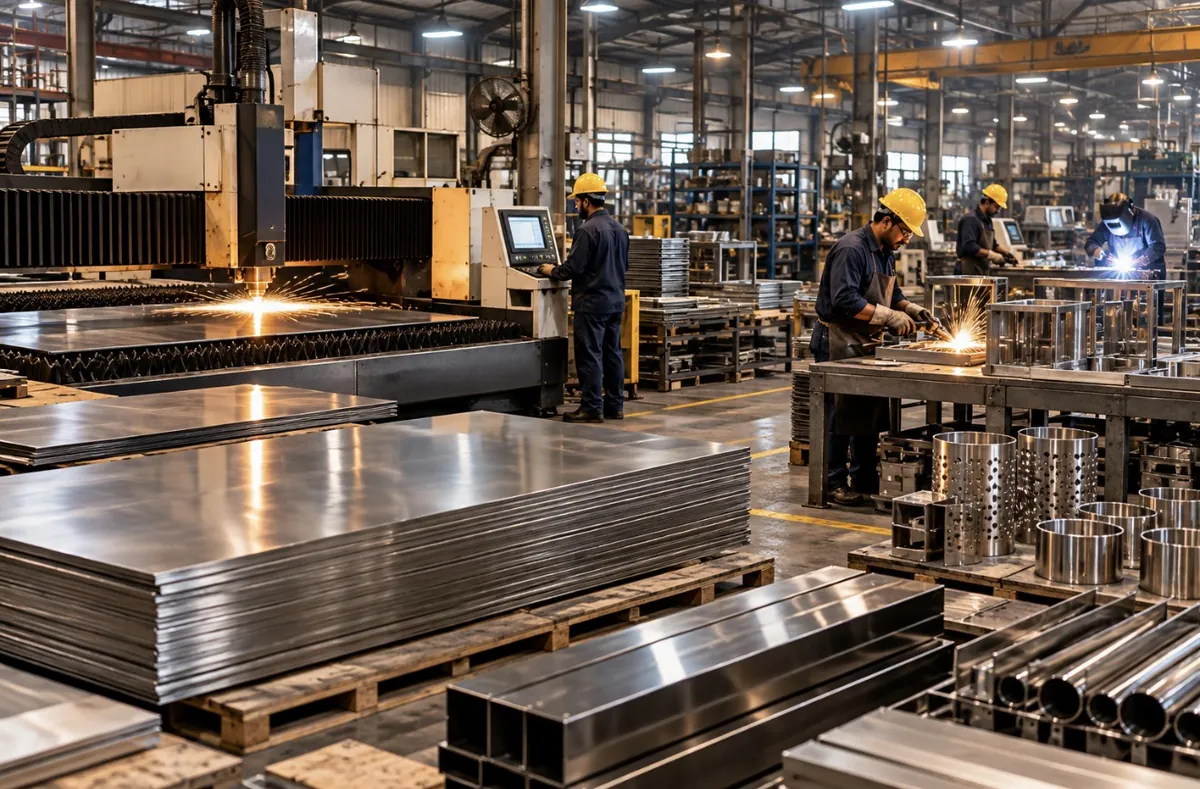
Utensil factories cut coils into blanks, form them on presses, trim, weld or rivet handles, then polish, clean and pack. Polishing is labour-intensive and largely decides finish quality. Delhi NCR, Mumbai and other centres host large export factories.

Quality control and inspection for stainless steel utensils

  • Steel grade verification by XRF or spectrometer
  • Gauge measurement at several points
  • Weight per piece within tolerance
  • Polish quality, scratches and pitting
  • Weld, rivet and handle strength
  • Food-contact and corrosion testing where required

International compliance and export

Food contact

EU Regulation 1935/2004 and national rules such as Germany's LFGB, and US FDA requirements apply to items touching food.

Marking

Some markets expect food-contact symbols and grade or care information.

Induction claims

Induction compatibility should be tested on the finished product.

Requirements change and depend on the product and destination, so confirm them with your compliance adviser or customs broker.

Sourcing notes for importers, retailers and brands

Weight and grade are the two specifications most likely to drift between sample and bulk. Agree both in writing and verify them on random bulk pieces.

Hospitality buyers should specify heavier gauges and durable finishes, while retail buyers often balance weight against price and packaging appeal.

More buyer questions about stainless steel utensils

Is 304 stainless steel magnetic?

Austenitic 304 is generally non-magnetic, though cold working can add slight magnetism; 430 is magnetic.

Can you make induction cookware?

Yes, with suitable bases, tested on induction hobs.

How do you check steel grade?

With XRF or spectrometer tests on samples and random bulk pieces.

Sourcing this category for your country

Buyer questions

Which stainless steel grade is best for kitchenware?

SS 304 (18/8) is the usual choice for food-contact kitchenware because of its corrosion resistance. SS 430 (18/0) is magnetic and cheaper, and is used for some economy and induction items. SS 201/202 lowers cost by replacing some nickel with manganese, but is less corrosion resistant. We name the grade in the specification and check it on production.

Where are stainless steel utensils made in India?

Major centres include Jagadhri in Haryana, the Delhi NCR and the Mumbai–Thane region for utensils and kitchenware, and Moradabad for serveware, barware and hotelware. We match each product to units with the right forming and polishing capability.

How do you verify the steel grade?

We ask for the mill certificate for the steel lot. On samples and production we confirm the grade with a handheld analyser reading or an independent lab report, depending on what the programme requires.

What is the minimum order for stainless steel houseware?

It depends on the forming method and finish. Standard shapes from existing tools allow moderate minimums. New shapes need tooling, and PVD colours or custom packaging add setup. We confirm minimums with the factory for your specification.

Can you develop custom stainless steel products under my brand?

Yes. We develop from drawings, references or samples, agree tooling cost and ownership in writing, and coordinate branding and retail packaging.

Do you handle food-contact testing?

We arrange food-contact tests with recognised labs to the destination market's requirements, for example EU 1935/2004 and LFGB tests for Germany. Final compliance responsibility sits with the importer.

Submit your product requirements

Request a stainless steel houseware sourcing consultation

Share a photo, reference product or tech pack. We will identify suitable verified manufacturers and explain the next steps — no obligation.

Phone & WhatsApp
+91 93684 37527

Up to 5 files (JPG, PNG, WEBP or PDF), 10 MB each. Files are stored privately.

Required: Name, Email and Product. We reply within one working day.