Cookware · Pots and pans sourcing for US buyers
Stainless Steel Pots and Pans Manufacturers in India
Pots and pans are sold both as open stock and as matching pieces in a range. US retailers, restaurant suppliers and e-commerce brands buy individual stockpots, saucepans, frying pans, sauté pans and woks to fill price points and sizes that sets do not cover.
This page covers individual pots and pans: construction, sizes, handles and lids. For boxed sets and the wider cookware range, see our stainless steel cookware manufacturers page.
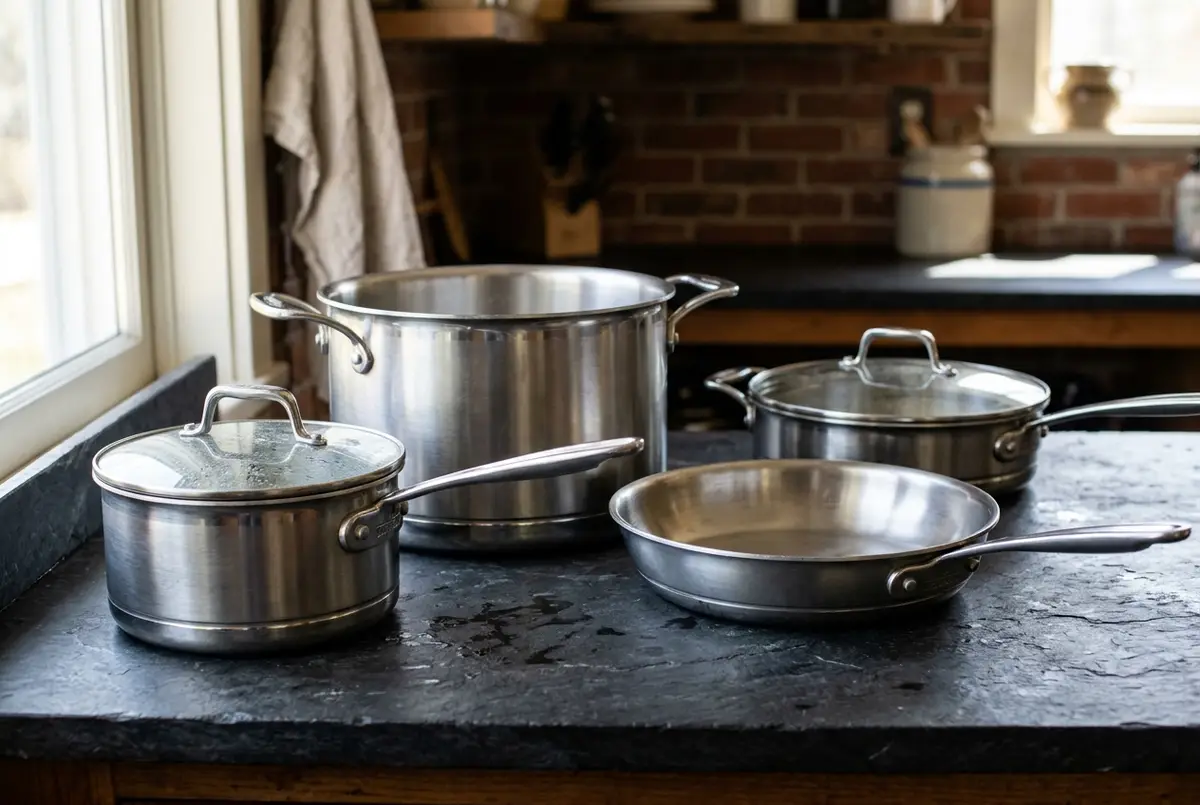
Pots and pans we source
Stockpots from small soup pots to large commercial capacities; saucepans with lids and pour spouts; frying pans and skillets; sauté pans with helper handles; woks and stir-fry pans; casseroles and Dutch-oven style pots; steamer inserts and pasta pots with strainer baskets; and commercial-weight pans for restaurant and catering use.
Base and body construction
Impact-bonded bases press an aluminium disc between steel layers under the pan; they are economical and widely used. Encapsulated bases enclose an aluminium or copper core in a steel capsule, giving better heat spread on the base only. Fully clad tri-ply runs steel, aluminium and steel through the whole body, including the walls, for even heating; five-ply adds further layers. Heavy-gauge single-ply steel is used for some stockpots and commercial pans where durability matters more than heat spread.
For induction compatibility the outer layer must be magnetic, usually SS 430. We test each sample on an induction hob and repeat the test on production pieces.
Product specifications to agree
Diameter, height and capacity in US units as well as metric; body and base thickness separately; inner and outer grades (commonly SS 304 inner, SS 430 outer on induction pieces); base type and diameter; handle type and attachment; lid material and fit; rim design (flat or flared for drip-free pouring); interior markings for capacity; and finish inside and outside. For US retail, include oven-safe temperature claims only where the handles and lids have been tested.
Handles, lids and finishes
Handles may be cast stainless steel, tubular steel, or steel with silicone or phenolic grips, attached by rivets, welding or screws. Riveted handles are strong but create rivet heads inside the pan; welded handles leave a smooth interior but need sound welds. Lids are stainless steel or tempered glass with steam vents. Finishes include mirror polish, brushed satin, a combination of both, and hammered textures.
Coated pans and claims
Some buyers want stainless pans with non-stick interiors. Coatings need the coating supplier's documentation and the tests your market requires. Several US states have introduced restrictions or disclosure requirements for intentionally added PFAS in cookware, so check the rules for each state you sell into before choosing a coating or making a "PFAS-free" claim.
Manufacturing capabilities in India
Pots and pans are made by deep drawing on hydraulic presses, followed by trimming, base bonding or cladding, handle attachment and polishing. Tri-ply requires clad sheet, which some factories import and others source from Indian rolling mills. Jagadhri, the Mumbai–Thane region and the Delhi NCR all have cookware units; capability differs between them, so we match each piece to the right factory.
Minimums and customisation
Existing sizes and shapes from a factory's tooling allow moderate minimums per item. New diameters or shapes need dies; new clad constructions and custom handles add setup. Laser or etched branding on bases and handles, custom lids and retail packaging are all possible. We confirm minimums in writing for your specification rather than quoting a general figure.
What we inspect
Grade on inner and outer layers, body and base thickness, base bonding with no gaps or separation at the edge, base flatness when cold and after heating, induction response, handle and rivet strength under an agreed load, lid fit, capacity, polish and scratches, origin marking and labels, and carton drop performance for e-commerce.
Who buys pots and pans from India
US buyers include kitchenware importers adding open-stock lines next to existing sets, restaurant and catering distributors buying heavy-gauge stockpots and sauce pans, e-commerce brands launching a hero pan, and department stores filling price points within a cookware range. Starting with one base construction across several sizes keeps tooling and approvals manageable, and allows later expansion into sets.
Related houseware categories
Verification, quality and private-label services
Buyer guides for US importers
More for US buyers
Buyer questions
What is the difference between tri-ply and encapsulated pans?
Tri-ply clads aluminium between steel through the whole body; encapsulated pans put the aluminium only in the base. Tri-ply heats the walls more evenly; encapsulated bases cost less.
Can Indian pots and pans work on induction?
Yes, when the outer layer is magnetic stainless steel such as SS 430. We test every sample and production lot on an induction hob.
Can I buy single pans instead of sets?
Yes. Open-stock pots and pans can be sourced by size and style.
Are riveted or welded handles better?
Both work. Riveted handles are very strong; welded handles give a smooth interior. Either must pass an agreed load test.
Can you put my brand on the base?
Yes, by laser, etching or stamping, approved on samples.
Submit your product requirements
Request a quote from Indian manufacturers
Share a photo, reference product or tech pack. We will identify suitable verified manufacturers and explain the next steps — no obligation.
- Phone & WhatsApp
- +91 93684 37527