USA buyers · Stainless steel houseware & homeware sourcing
Stainless Steel Housewares & Kitchenware Sourcing from India for US Buyers
US importers, retailers, wholesalers, distributors, hospitality suppliers and private-label brands buy a large share of their stainless steel housewares from Asia. India is a strong alternative and complement to other sourcing countries for cookware, kitchen tools, tableware, serveware, storage, drinkware, barware and hotelware.
Sourcing India is a housewares sourcing company that works on the buyer's side. We help American buyers find and verify Indian kitchenware manufacturers, develop and sample products, specify the right stainless steel grade, monitor production, inspect goods and coordinate export to US ports.
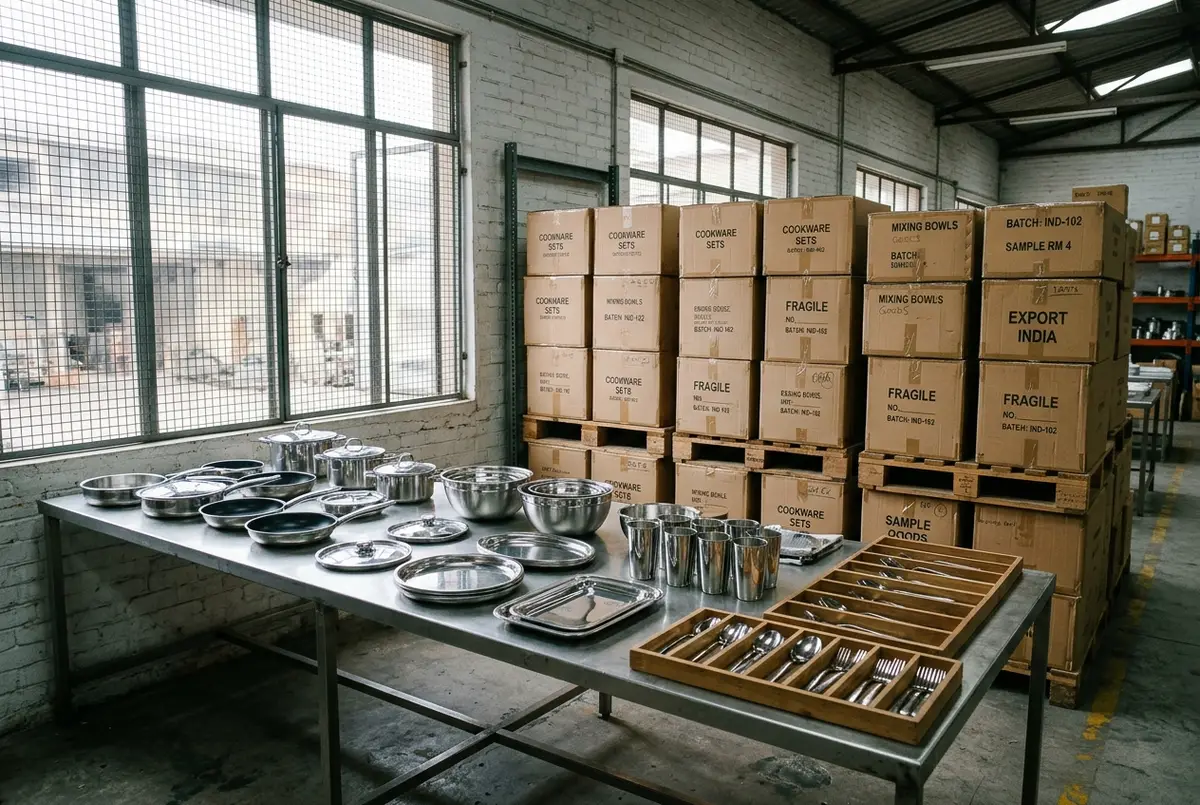
Why US importers source housewares from India
Diversification is the main reason. Many American retailers and importers want a second country for categories they already buy elsewhere, so that a single tariff change, port disruption or capacity squeeze does not stop their supply. India has a long-established stainless steel utensil industry, a large domestic market that keeps factories busy year-round, and an English-speaking export community used to working with US buyers.
India is particularly strong in deep-drawn and spun stainless steel products, such as bowls, plates, trays, containers, tiffins and cookware bodies, and in finishing-intensive metalware such as hammered, mirror-polished and PVD-coloured serveware, barware and flatware. It also combines steel with other materials made in the same regions, including wood, marble, brass, copper and glass, which helps buyers build coordinated kitchen and dining collections from one country.
India is not the right answer for every product. Highly automated, very high-volume items or products with complex imported components may be more competitive elsewhere. An honest feasibility check at the start, comparing specification, landed cost and lead time, is part of our process.
Indian stainless steel manufacturing capabilities
Indian houseware manufacturing is organised in clusters of specialised units. Haryana's Jagadhri (Yamunanagar) region is known for drawn and spun utensils, bowls, plates and cookware. The Delhi NCR has sheet processing, kitchen tools and export houses that consolidate orders across workshops. The Mumbai–Thane region makes utensils, storage, hotelware and kitchenware close to the Nhava Sheva (JNPT) port. Moradabad in Uttar Pradesh is India's best-known metalware centre for serveware, barware, hotelware and decorative steel, often combined with brass, copper or PVD finishes.
Common forming methods include deep drawing on hydraulic presses, metal spinning, pressing and stamping, wire forming, fabrication and TIG welding, impact bonding of cookware bases and cladding for tri-ply construction. Finishing ranges from mirror and satin polishing to bead blasting, hammering, PVD colour coating, powder coating and laser branding. Not every factory does every process, so matching your product to the right unit matters more than the size of the factory.
Stainless steel grades and specifications
Most food-contact housewares use SS 304, an austenitic grade with about 18% chromium and 8% nickel, often marketed as 18/8. It offers good corrosion resistance and forms well in deep drawing. SS 316 adds molybdenum for better resistance to salt and acids and is used for some premium cookware and drinkware. SS 430 is a ferritic, magnetic grade with almost no nickel. It is cheaper and is used for induction cookware bases, economy flatware (18/0) and some trays and tools. SS 201 and 202 replace part of the nickel with manganese. They cost less but resist pitting and staining less well.
The grade is only part of the specification. Sheet thickness in millimetres with a tolerance, weight per piece, forming method, finish, edge treatment, weld quality, lids, gaskets and handles all affect quality and price. We write these into a specification and a sealed golden sample before production, and we verify the grade with mill certificates and, where the programme requires it, a handheld analyser reading or an independent lab test on production pieces. Grade substitution, such as SS 201 supplied as SS 304, is the most common quality dispute in this category.
Product development and sampling
Most American programmes start from one of three points: a factory's existing range, a reference product the buyer already sells, or new drawings. We turn each into a costed specification, confirm whether new tooling is needed, and agree tooling cost and ownership in writing before any money is spent.
Sampling usually runs in stages: a development sample to check shape and function, a pre-production sample in the approved grade, thickness and finish, and a sealed golden sample that every production lot is measured against. Allow time for at least two rounds on new designs, and longer where moulds, PVD colours or custom packaging are involved.
Private label and OEM manufacturing
Many US retailers, e-commerce brands and distributors sell Indian-made housewares under their own brand. Private label may mean your logo and packaging on a factory's standard design, an ODM product adapted from the factory's range, or a fully custom OEM product built to your drawings. Each route has different tooling costs, minimum order quantities and lead times.
We coordinate laser, etched or embossed branding, retail packaging, inserts, barcodes and marketplace-ready cartons, and we keep the specification and golden sample on file so that re-orders match the first order. See our private label cookware and private label cutlery pages for category-specific guidance.
Factory identification and verification
We shortlist manufacturers by forming method, finishing capability, export experience and the price level you need. Verification covers the legal entity and export registration, ownership of the production site, equipment, in-house versus subcontracted processes, capacity for your volume, quality controls and, where your programme requires it, social-compliance audits.
Trading companies and export houses can be the right choice for mixed containers, but you should know who actually makes each item. We document the producing unit for every product, so that a quality issue can be traced and corrected.
Quality control and production monitoring
Inspection starts before production with material checks and a signed golden sample. During production we check thickness, weight, forming, welds and polishing, and we catch problems while they can still be corrected. Final random inspection follows ANSI/ASQ Z1.4 or ISO 2859-1 sampling with AQL levels agreed in your purchase order, often 0 for critical, 2.5 for major and 4.0 for minor defects.
Function tests depend on the product: induction tests on cookware bases, leak tests on sealed containers, retention tests on insulated drinkware where a claim is made, handle load checks and coating adhesion checks on PVD or powder-coated pieces. You receive a photo report before the balance payment and container loading.
Packaging and retail-ready products
US retail and e-commerce channels each have their own packaging rules. Big-box retailers often issue vendor manuals covering carton dimensions, labels, UPC or GTIN barcodes and pallet configuration. Marketplaces such as Amazon have their own packaging and labelling requirements for inbound shipments. Protective film, nesting, inner packs and drop-tested master cartons reduce transit damage.
Packaging is designed with the product, not after it. Box sizes affect container loading and freight cost, and printed packaging has its own lead time and minimums. We approve artwork, barcodes and carton marks before printing and check them again at final inspection.
Export documentation and shipment coordination
A typical shipment from India to the United States needs a commercial invoice, packing list, bill of lading or air waybill, and a certificate of origin where required. On the US side, your customs broker files the entry, and ocean shipments need an Importer Security Filing (ISF) before loading. The importer of record is responsible for the correct HTS classification, valuation, duties and marking.
Tariff treatment of steel housewares has changed several times and can differ by HTS code. Check the current duty position for your exact product with your customs broker before you place an order. We coordinate with your forwarder on booking, loading supervision and documents, and can work with your nominated forwarder or introduce one.
US compliance basics for stainless steel kitchenware
Food-contact articles sold in the US must not adulterate food under the Federal Food, Drug, and Cosmetic Act, and coatings, plastics and silicone parts must use substances permitted for food contact. FDA does not certify or approve factories for kitchenware, so a claim that a factory is "FDA certified" should be questioned. Buyers usually hold grade evidence and test reports from recognised labs as part of their compliance file.
California Proposition 65 may require a warning where a product can expose consumers to listed chemicals, such as lead or nickel in some alloys or components, unless exposure is below the safe-harbour level. Children's tableware and drinkware need third-party testing and a Children's Product Certificate under CPSC rules. Knives, forks and vacuum containers must be permanently marked with their country of origin (19 CFR 134.43). Requirements set by law differ from requirements set by individual retailers, and we separate the two in your specification.
Support for American importers and retailers
We work with US time zones for calls and reviews, quote in US dollars on FOB or other agreed terms, and report in plain English with photos and measurements. Typical clients include importers and distributors adding a second sourcing country, retailers and department-store suppliers developing private-label ranges, e-commerce brands launching a kitchenware line, hospitality suppliers buying hotelware and catering supplies, and promotional companies ordering branded drinkware.
For cutlery and flatware specifically, see our US stainless steel kitchenware and cutlery sourcing page. For each product category, the pages below explain specifications, finishes, manufacturing methods, minimums and inspection points.
Stainless steel and homeware categories we source
Verification, quality and private-label services
Buyer guides for US importers
More for US buyers
Buyer questions
Is India a good source of stainless steel kitchenware for the US market?
Yes, especially for drawn and spun steel products, cookware, storage, tableware, serveware, barware and hotelware. Fit depends on your product, volume and target price, which we check at the start.
Do you work only with FDA-certified factories?
FDA does not certify kitchenware factories. We check materials, coatings and components against your requirements and arrange tests at recognised labs where needed; the importer holds the compliance file.
What is the minimum order for stainless steel housewares from India?
It depends on the forming method, finish and packaging. Existing designs allow moderate minimums; new tooling, PVD colours and printed packaging raise them. We confirm minimums with the factory for your specification.
Can you develop a private-label kitchenware range?
Yes. We develop from references or drawings, agree tooling ownership, coordinate branding and retail packaging, and match re-orders to the golden sample.
How do you verify the steel grade?
With mill certificates per lot, plus a handheld analyser reading or independent lab test on production pieces where the programme requires it.
Which US ports do shipments go to?
Shipments usually sail from Nhava Sheva (JNPT), Mundra or Chennai to East Coast, Gulf or West Coast ports, depending on your warehouse location and your forwarder's routing.
Submit your product requirements
Request a quote from Indian manufacturers
Share a photo, reference product or tech pack. We will identify suitable verified manufacturers and explain the next steps — no obligation.
- Phone & WhatsApp
- +91 93684 37527