Kitchen prep · Mixing bowl sourcing for US buyers
Stainless Steel Mixing Bowls Manufacturers in India
Mixing bowls are one of India's most competitive stainless steel exports. They are deep drawn or spun from sheet, nest efficiently in a container, and suit both retail kitchenware ranges and commercial kitchens.
This page covers food-preparation and mixing bowls. Serving bowls, plates and trays are covered on our stainless steel tableware page.
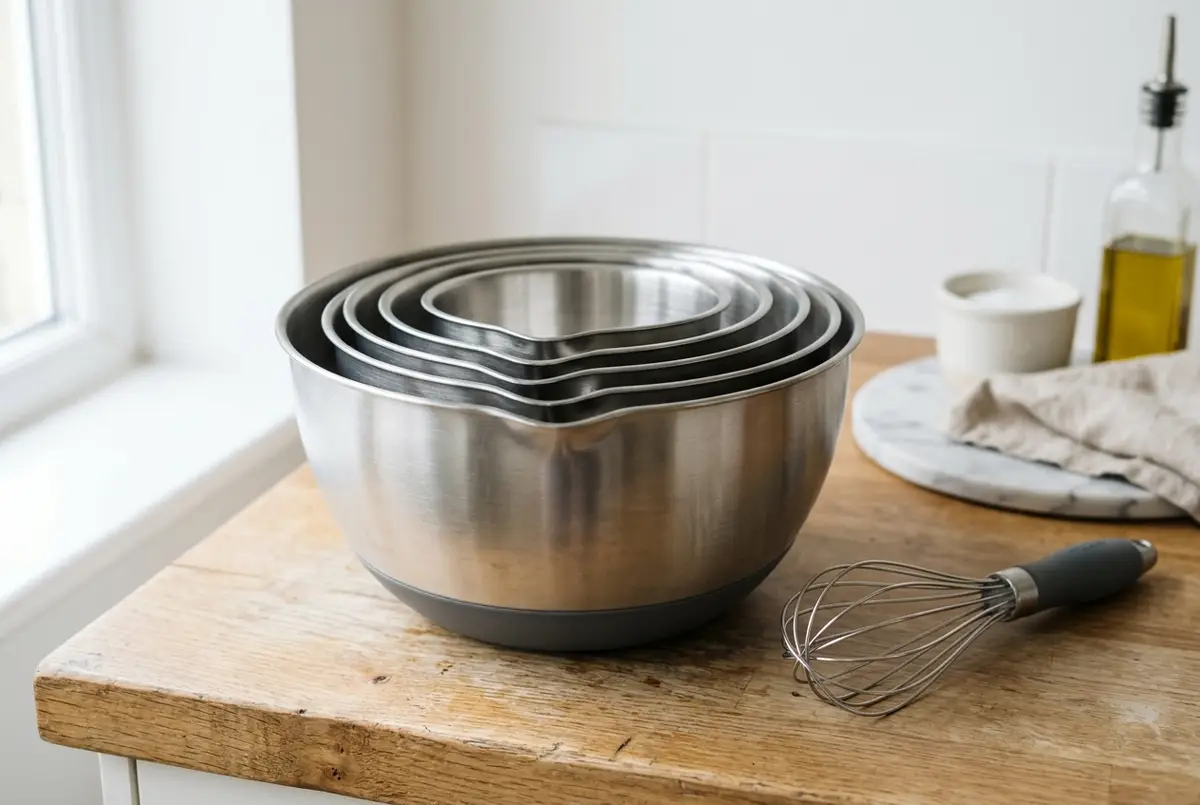
Mixing bowls we source
Nesting sets of three to ten bowls; deep and wide-rim mixing bowls; bowls with silicone or rubber non-slip bases; bowls with pouring spouts and handles; lidded prep bowls and storage bowls; measurement-marked bowls; double-wall insulated bowls; commercial and bakery bowls in large capacities; and mini prep bowls for ingredient preparation.
Specifications to agree
Capacity in quarts and litres, top diameter and depth, sheet thickness in millimetres with a tolerance, weight per bowl, rim style (rolled, flat or wide), base style (flat, ring or non-slip), interior markings, and finish inside and outside. For sets, specify the nesting dimensions so bowls stack without sticking and the set fits the retail box.
Material and finish options
SS 304 is the usual grade for mixing bowls because of its corrosion resistance and formability. SS 430 and SS 201/202 lower the cost but resist staining less well, particularly with salt and acidic ingredients. Finishes include mirror, brushed satin, matte, mirror outside with satin inside, hammered, and colour on the outside by powder coating or PVD. Silicone bases and lids should be specified as food-contact grade with documentation.
Manufacturing methods
Deep drawing on hydraulic presses produces consistent shapes quickly once dies exist. Spinning on a lathe suits smaller runs and some shapes without full dies. After forming, the rim is curled or rolled, the bowl is annealed if needed, polished and cleaned. Non-slip bases are moulded or bonded separately. Jagadhri and the Mumbai–Thane region are major centres for drawn and spun bowls.
Retail and commercial ranges
Retail buyers usually want nesting sets with a printed box or sleeve, measurement markings and gift-ready presentation. E-commerce sellers need drop-tested packaging and clear capacity labelling. Commercial kitchens and bakeries prefer heavier gauges, larger capacities and plain finishes that tolerate daily washing.
Minimums and customisation
Standard sizes from existing dies allow moderate minimums per size. New shapes, spouts or handles need tooling. Coloured exteriors, custom silicone colours and printed packaging add setup per design. Laser or etched logos can be applied to the base or rim.
What we inspect
Thickness and weight per size, rim smoothness with no sharp edges, base flatness, nesting fit, polish consistency, silicone base adhesion, lid fit where included, capacity markings, packaging and carton marks.
US buyer notes
Mixing bowls are food-contact articles, so keep grade evidence and test reports for coatings and silicone parts. Retail packaging should show capacity, material, care guidance and country of origin. If you sell into California, check whether any component may require a Proposition 65 warning.
Who buys mixing bowls from India
Typical buyers include US kitchenware importers building a core prep range, department-store and specialty kitchen retailers looking for coordinated bowl, colander and measuring sets, e-commerce brands selling nesting sets with lids, bakery and restaurant supply distributors, and gift companies that combine bowls with wooden spoons or marble boards. Because bowls nest well, they are often the anchor item that fills a mixed container alongside smaller tools. A practical starting range is one bowl family in three to five sizes and one finish, extended later with lids, non-slip bases or coloured exteriors once quality and lead time are proven on a first order. Keep the size ratio realistic: mid-size bowls usually sell fastest, so the order mix should reflect sales data rather than equal quantities per size.
Related houseware categories
Verification, quality and private-label services
Buyer guides for US importers
More for US buyers
Buyer questions
Which grade is best for mixing bowls?
SS 304 is the usual choice for durability and corrosion resistance.
Can bowls have non-slip silicone bases?
Yes, with food-contact silicone specified and adhesion checked.
How many bowls are in a typical set?
Retail sets often have three to six bowls; larger nesting sets go up to ten.
Can the outside be coloured?
Yes, with powder coating or PVD, checked for adhesion and dishwasher performance.
Do you supply commercial mixing bowls?
Yes, in heavier gauges and larger capacities.
Submit your product requirements
Request a quote from Indian manufacturers
Share a photo, reference product or tech pack. We will identify suitable verified manufacturers and explain the next steps — no obligation.
- Phone & WhatsApp
- +91 93684 37527