Sourcing Guide · How it works
Sourcing Plastic Household Products From India
Sourcing household, storage and garden plastic products with material and moulding control.
01 · Overview
What this type of project involves
This guide explains how a plastic household sourcing project in India is typically structured when Sourcing India works on the buyer's side — from defining the requirement to shipment. It describes our method, not a specific client engagement.
- Product development and specification
- Factory identification for injection-moulded products
- Material and colour management
- Sampling and production QC
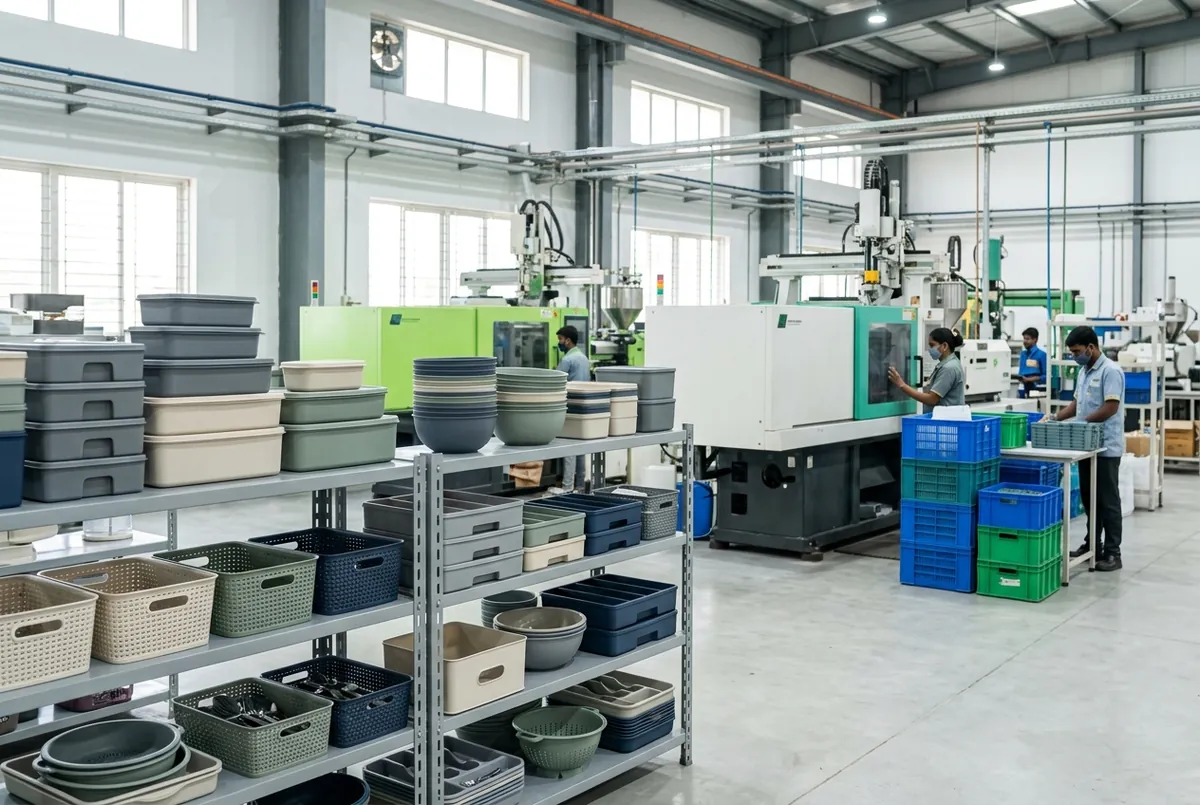
Indian manufacturers produce injection- and blow-moulded household products such as storage containers, kitchenware, bottles, garden and utility items. Quality depends heavily on the mould, the polymer grade and process control.
Mould ownership, material grade and food-contact compliance should be agreed before any tooling is cut.
What to specify
What to include in your brief
- Product drawings or 3D files with wall thickness
- Polymer type and grade (for example PP, PET, HDPE), and recycled content if needed
- Colour standards and any transparency requirements
- Food-contact, BPA-free or other claims for the destination
- Mould ownership and tooling cost terms
Category checks
Quality checks specific to this category
- Dimensions and fit of lids and closures
- Wall thickness and weight per piece
- Colour consistency and surface defects (flash, sink marks, short shots)
- Drop and load testing
- Food-contact testing where required
Cost & lead time
What drives cost and lead time
- Mould cost and number of cavities
- Polymer price and grade
- Part weight and cycle time
- Printing, labelling and packaging
Avoid
Common mistakes to avoid
- Not agreeing who owns the mould
- Allowing undeclared material substitutions
- Overlooking food-contact rules
Practical notes
Practical notes for buyers
Mould quality decides product quality for the life of the tool. Before tooling, agree the steel used for the mould, the number of cavities, the expected life and who keeps the mould. Sample parts from the first trial (T1) usually need adjustment before approval.
Material declarations should name the exact polymer grade. Substituting a cheaper grade or adding undeclared regrind can change strength, colour and food-contact compliance, so check weight and material on bulk.
Colour matching in plastics is done with masterbatch. Approve colour on moulded parts, not on swatches, because the moulding process affects the final shade.
02 · Where buyers struggle
Common challenges
- Finding manufacturers whose real capability matches the product, rather than trading companies
- Turning a reference or idea into a written specification factories can quote and sample against
- Keeping colour, size and finish consistent between the approved sample and bulk production
- Catching quality problems while they can still be corrected — not after the container ships
03 · Services involved
What Sourcing India does
04 · The process
Step by step
The requirement is defined, the relevant clusters are searched, factories are evaluated and verified, samples are developed and a golden sample is sealed. Quality and production are then controlled through to export.
06 · Quality control
Five checkpoints, not one inspection
Quality is controlled while the outcome can still change:
- 01Factory Audit
- 02Pre-Production
- 03During Production
- 04Pre-Shipment
- 05Loading
FAQ
Frequently asked questions
Who owns the mould?
This must be agreed in writing before tooling. Buyer-paid moulds should be documented as buyer property.
Can products use recycled plastic?
Often yes, but claims must be backed by supplier documentation, and food-contact use may be restricted.
What are common moulding defects?
Flash, sink marks, short shots, warping and colour streaks, all checked during inspection.
07 · Go deeper
Related category guide
Houseware manufacturers in India — products, materials, clusters, quality checks and buyer FAQs.
Have a product you want to source from India?
Tell us what you want to build. A photo, reference product or tech pack is enough to start.
Related guides