Sourcing Guide · How it works
Developing a Home Furnishing Supply Base Across India
Building a coordinated home-textile supply base for bedding, cushions, curtains and soft furnishings.
01 · Overview
What this type of project involves
This guide explains how a soft furnishings sourcing project in India is typically structured when Sourcing India works on the buyer's side — from defining the requirement to shipment. It describes our method, not a specific client engagement.
- Fabric and home-textile sourcing
- Product development from buyer briefs
- Factory sourcing across Panipat, Karur and Jaipur
- Quality control on GSM, shrinkage, colour and stitching
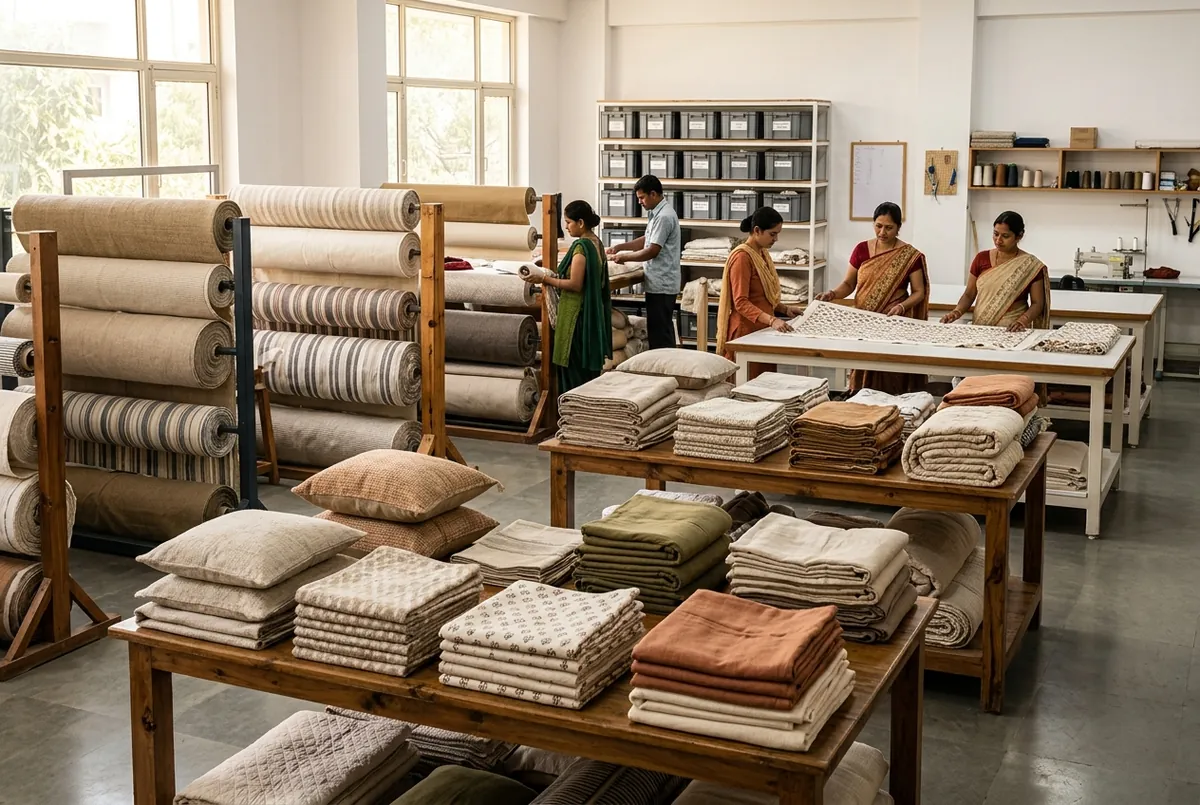
Home furnishings such as bedding, cushions, curtains, throws and table linen are made across distinct Indian textile centres. Panipat is known for made-ups and woven throws, Karur for cotton home textiles and table linen, and Jaipur for printed and hand-block textiles. A supply base often combines two or three of these centres.
Because home textiles are sold in sets and colour stories, consistency between products and between reorders matters as much as the quality of one piece.
What to specify
What to include in your brief
- Product list with finished sizes and tolerances for each item
- Fabric construction, thread count or GSM, fibre content and finish
- Colour standards: Pantone or physical swatches and the light source for approval
- Closures, piping, fillings and inserts specification
- Packaging: inserts, bands, bags and barcode requirements
Category checks
Quality checks specific to this category
- Shrinkage and dimensional stability after washing
- Colour-fastness to washing, rubbing and light where required
- Seam strength, closure function and stitch density
- Size and filling-weight checks on cushions, quilts and duvets
- Shade-band control across lots so sets match
Cost & lead time
What drives cost and lead time
- Yarn and fibre choice, for example cotton, linen, polyester or blends
- Dyeing method: yarn-dyed, piece-dyed or printed
- Hand work such as embroidery, quilting or block printing
- Order split across many colours and sizes
Avoid
Common mistakes to avoid
- Approving colours under different lighting from the store
- Not testing shrinkage on finished products
- Ordering coordinated items from different mills without a shared colour standard
Practical notes
Practical notes for buyers
Plan home-textile ranges around fabric bases. Using one base cloth across bedding, cushions and table linen reduces minimums, simplifies colour control and makes reorders faster. Where products need different fabrics, agree a shared colour standard and approve every lot against it.
Fillings deserve their own specification. Cushion inserts, quilts and duvets should state the fibre, weight and any certification required, and fill weight should be checked during inspection because it is easy to reduce without changing the look.
02 · Where buyers struggle
Common challenges
- Finding manufacturers whose real capability matches the product, rather than trading companies
- Turning a reference or idea into a written specification factories can quote and sample against
- Keeping colour, size and finish consistent between the approved sample and bulk production
- Catching quality problems while they can still be corrected — not after the container ships
03 · Services involved
What Sourcing India does
04 · The process
Step by step
The requirement is defined, the relevant clusters are searched, factories are evaluated and verified, samples are developed and a golden sample is sealed. Quality and production are then controlled through to export.
05 · Manufacturing clusters
Where this category is commonly made in India
As general industry geography, this category is commonly manufactured in and around Panipat, Karur, Jaipur. The right region and factory for a specific product are confirmed during sourcing, based on the product, quality level and volume.
06 · Quality control
Five checkpoints, not one inspection
Quality is controlled while the outcome can still change:
- 01Factory Audit
- 02Pre-Production
- 03During Production
- 04Pre-Shipment
- 05Loading
FAQ
Frequently asked questions
Which Indian cities make home textiles?
Panipat, Karur and Jaipur are major centres, alongside other regions for specific products. We match each item to the region and factory that makes it routinely.
How do you keep colours consistent across a bedding set?
By approving shades against one physical standard under agreed lighting, and checking shade bands for every lot before cutting.
Can home textiles be made in small quantities?
Often yes, especially with stock fabrics. Custom-dyed fabric usually carries a minimum per colour set by the dye house.
07 · Go deeper
Related category guide
Home furnishing & home textile manufacturers — products, materials, clusters, quality checks and buyer FAQs.
Have a product you want to source from India?
Tell us what you want to build. A photo, reference product or tech pack is enough to start.
Related guides